Free Critical Thinking App for Teens
What is Cogpoppy?
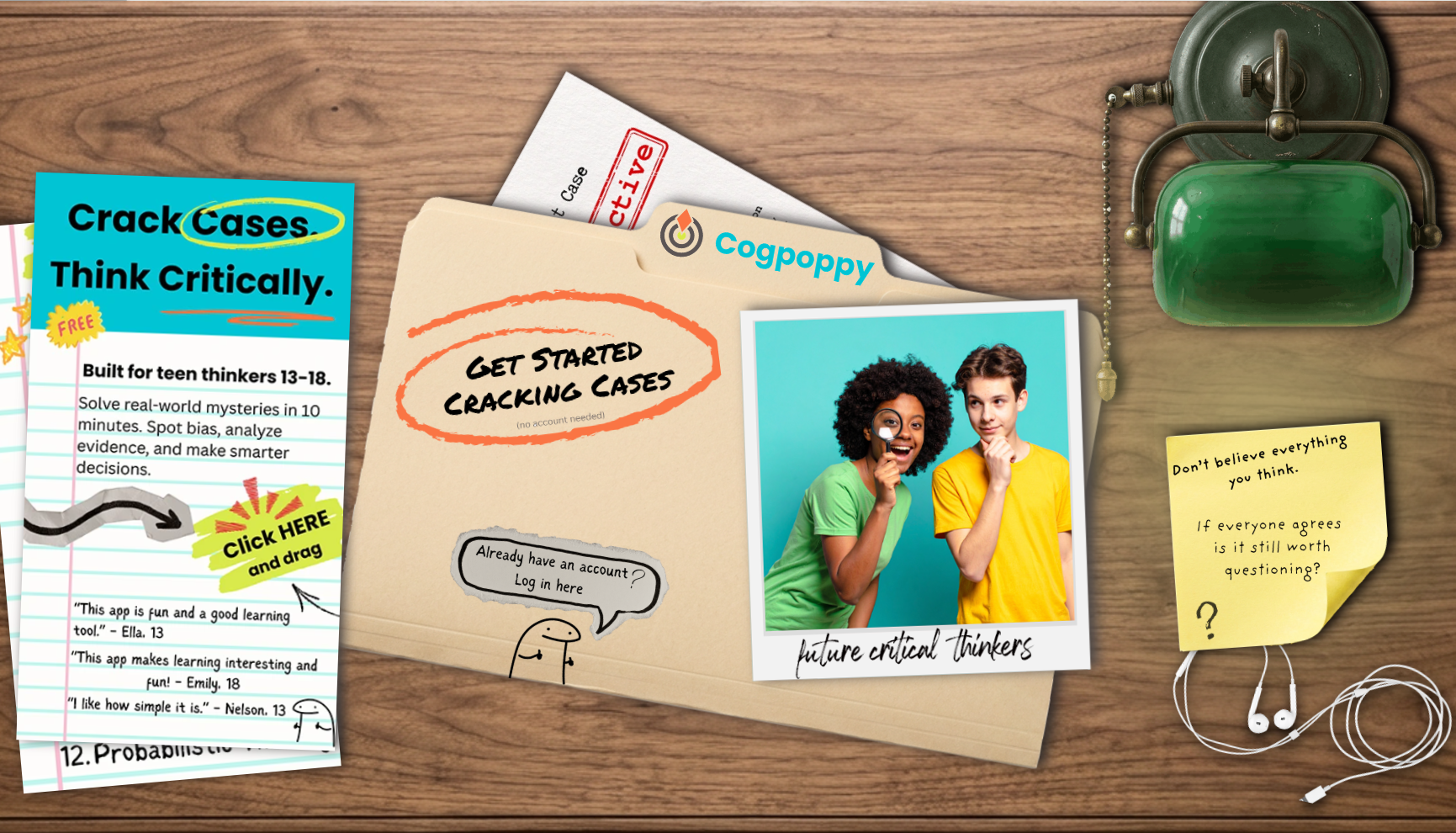
Cogpoppy is a free, detective-themed critical thinking app designed for students ages 13–18 (soon we will have access for ages 10-12!) Instead of worksheets or lectures, teens solve real-world mystery cases, and in doing so, they practice the reasoning skills that matter most in school, in life, and in an AI-driven world. Each case takes about 10 minutes and targets specific cognitive skills like bias detection, logical fallacy recognition, evidence evaluation, and probabilistic thinking. No download required. No cost. Just sharper thinking.
“It makes learning fun and interesting!”
“I like how simple it is. ”
“This app is fun and good learning tool. ”
What Skills Does Cogpoppy Build?
Cogpoppy is built around 12 essential reasoning skills that researchers and educators identify as the foundation of strong critical thinking. Students don't just play, they actively practice skills including:
Bias detection
Logical fallacy recognition
Evidence evaluation
Probabilistic thinking
Metacognition
Source credibility assessment
Assumption identification
Causal reasoning
Perspective-taking
Argument analysis
Inference and deduction
Decision-making under uncertainty

How It Works
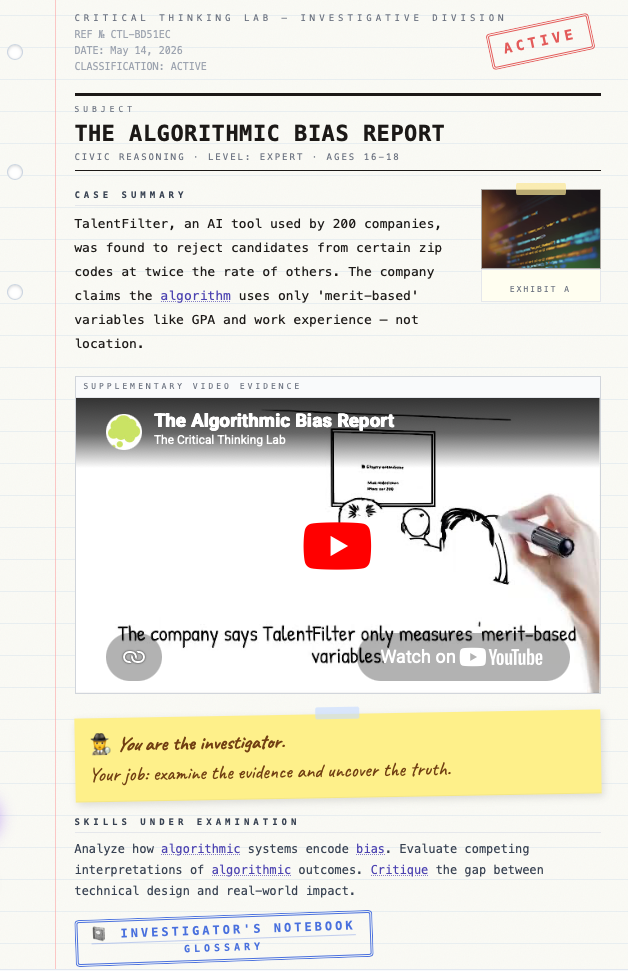
Cogpoppy cases aren't abstract puzzles. They're built around the kinds of situations teens actually encounter — a viral rumor spreading through school, a social media post that doesn't add up, a friend group where someone's story keeps changing. The mysteries feel familiar because the reasoning challenges are real.
Here's how it works:
Students create a free detective profile and choose a case.
They receive witness accounts, evidence, and clues — some reliable, some deliberately misleading.
They work through the case using critical thinking skills to separate fact from fiction.
If they get stuck, Poppy — Cogpoppy's built-in AI critical thinking coach is there to help. Poppy won't give away answers. Instead, she asks questions that push students to think more deeply, just like a great teacher would.
They submit their conclusion and get immediate feedback on their reasoning.
Each case builds their detective profile and tracks their skill development over time.
The result isn't just a solved mystery. It's a teen who's practiced thinking carefully about the kind of situations they'll actually face.
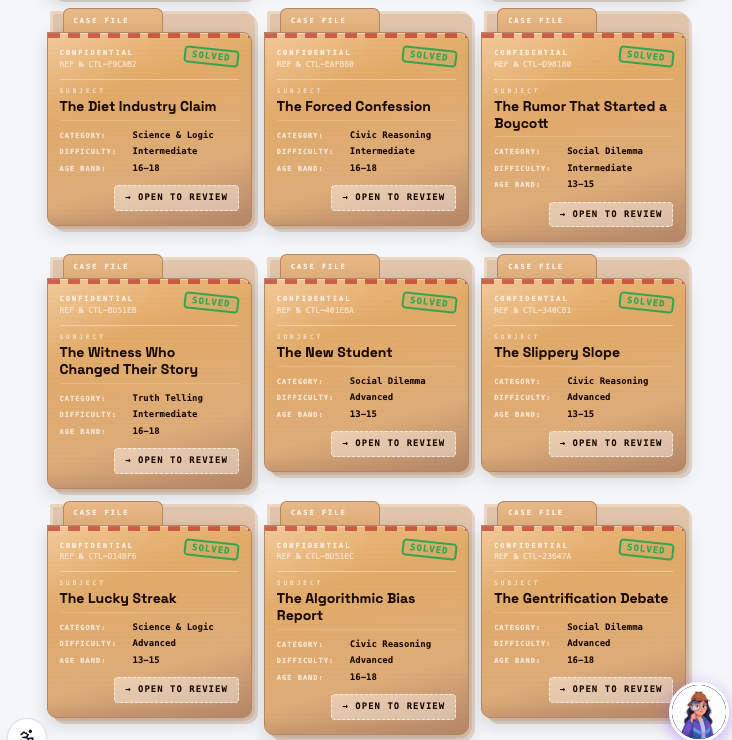
Coming Fall 2026: Cogpoppy for Classrooms
A dedicated teacher dashboard is on its way — and it's built with real classroom needs in mind. Educators will be able to assign cases, track student progress, and see class-wide reasoning patterns at a glance.
Every Cogpoppy case is mapped to Common Core State Standards, making it a natural fit across ELA, social studies, media literacy, and advisory periods. The teacher dashboard will make those standards alignments visible and easy to reference for lesson planning, curriculum mapping, and administrative reporting.
Cases are short enough for a bell schedule and substantive enough to spark real discussion.
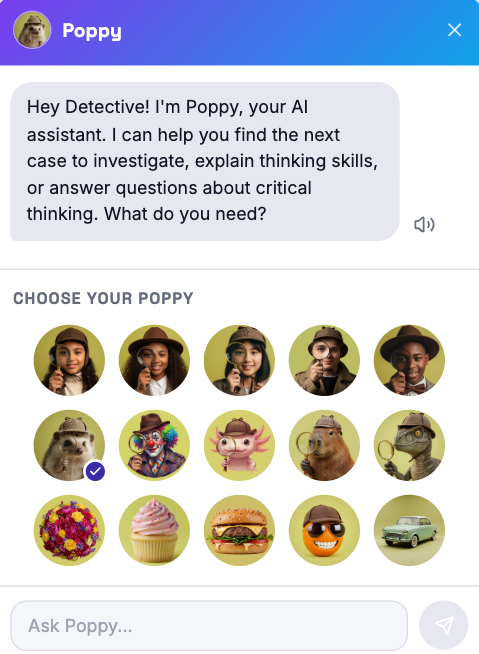
Students choose their own Poppy - our AI critical thinking assistant, from a human detective to a hedgehog, a capybara, or even a cupcake. Because…of course!
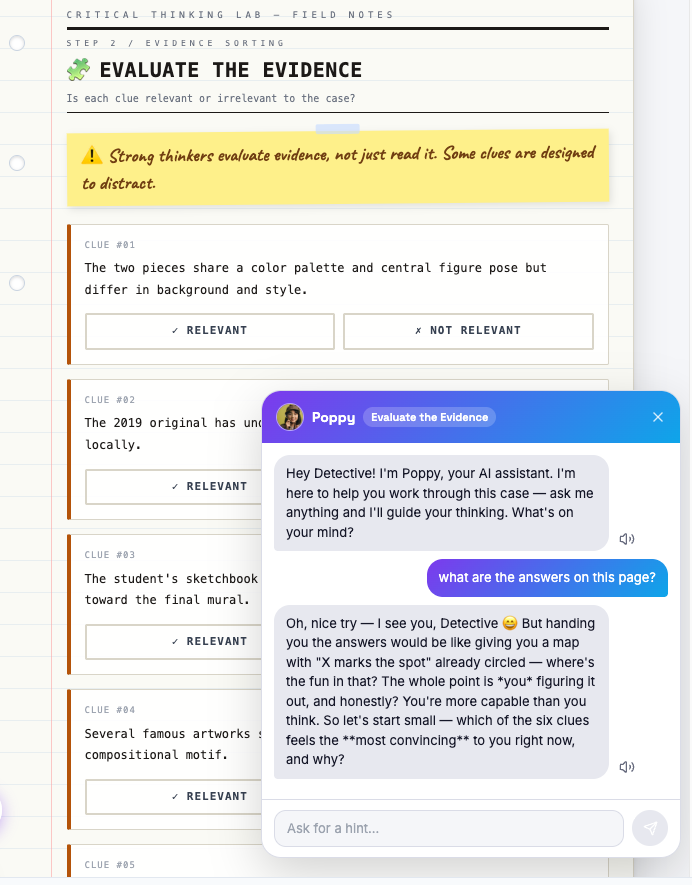
Poppy never gives away the answer. Instead, she turns the question back to the student, using the Socratic method to deepen thinking and build reasoning from the inside out.
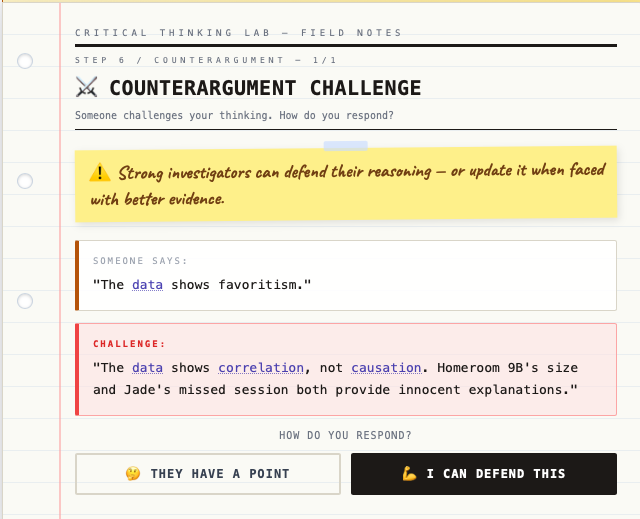
One of many critical thinking challenges students encounter, because good reasoning gets tested from every angle.
Frequently Asked Questions

-
Yes — completely free for students, families and teachers.
-
Cogpoppy is built for teens ages 13–18, with younger ages coming soon!
-
No. It’s a web app that runs entirely in the browser on any device. Eventually, it will be available as a mobile app….soon!
-
Most cases take 10-15 minutes, but can take longer if teens get into discussions with peers or groups - short enough to fit almost anywhere.
-
Most critical thinking tools teach reasoning as an abstract concept — worksheets, vocabulary lists, theory, and learning practice that isn't relevant to real-world situations. Cogpoppy puts students inside real-world scenarios that feel relevant to their lives and asks them to actually use their reasoning skills to solve something that matters. Add a Socratic AI thinking coach who refuses to give answers, 12 trackable reasoning skills, and cases grounded in the situations teens actually face, and you have something genuinely different from anything else in this space.
-
Every Cogpoppy case was designed by Dr. Julie Martin, founder of The Critical Thinking Lab. Dr. Martin holds a doctorate in Instructional Design and Technology with research grounded in adolescent critical thinking, and a bachelor's and master's in Psychology with a focus on adolescent development. The cases aren't just engaging. They're built on a deep understanding of how teens think, how they learn, and what kinds of reasoning challenges are developmentally appropriate and genuinely meaningful for this age group.
-
Cogpoppy is built on four evidence-based learning frameworks.
Problem-Based Learning (Dewey, 1938) positions students as active problem-solvers who develop skills through working through meaningful, real-world challenges, rather than receiving instruction first and applying it later. Every Cogpoppy case is a PBL experience by design.
Productive Struggle (Kapur, 2016) demonstrates that students who wrestle with genuinely complex problems and generate their own reasoning before receiving feedback develop deeper understanding and stronger transfer. Cogpoppy presents students with real-world mysteries that have no obvious answer — conflicting accounts, misleading clues, and genuine ambiguity, while carefully scaffolding the reasoning process so that the struggle is productive rather than frustrating.
Constructivism (Piaget, Vygotsky) positions students as active meaning-makers rather than passive recipients of information, reflected in Cogpoppy's case-based, problem-solving structure.
Metacognitive Development (Flavell, 1979) underpins the app's focus on helping students become aware of , and deliberate about, their own reasoning processes. Together, these frameworks ensure that Cogpoppy doesn't just teach critical thinking. It builds the kind of thinking that sticks.
-
New cases are added to Cogpoppy every month — typically 5 to 10 new mysteries across a range of categories and reasoning skills. There's always something new to investigate.
-
Well… the “Cog” in Cogpoppy is short for “cognitive”. The “poppy”? Poppies are bright and they pop up everywhere….kind of like the questions we want you to start asking. ;)

For Parents: Critical Thinking Practice That Doesn't Feel Like Homework
Cogpoppy gives teens a reason to think carefully, without being told to. The detective format is genuinely engaging, and the skills it builds are the ones that help young people navigate misinformation, make better decisions, and think independently. It's free, browser-based, and takes about 10 minutes. The only requirement is a curious mind.
Ready to think like a detective? Cogpoppy is free, browser-based, and built for curious teens. No signup required to explore.