What a Disappearing Homework Assignment Has to Do With Your Teen's Social Media Feed
Two people. Opposite claims. And just enough background information on both of them to make you feel like you already know what happened. That last part is intentional.
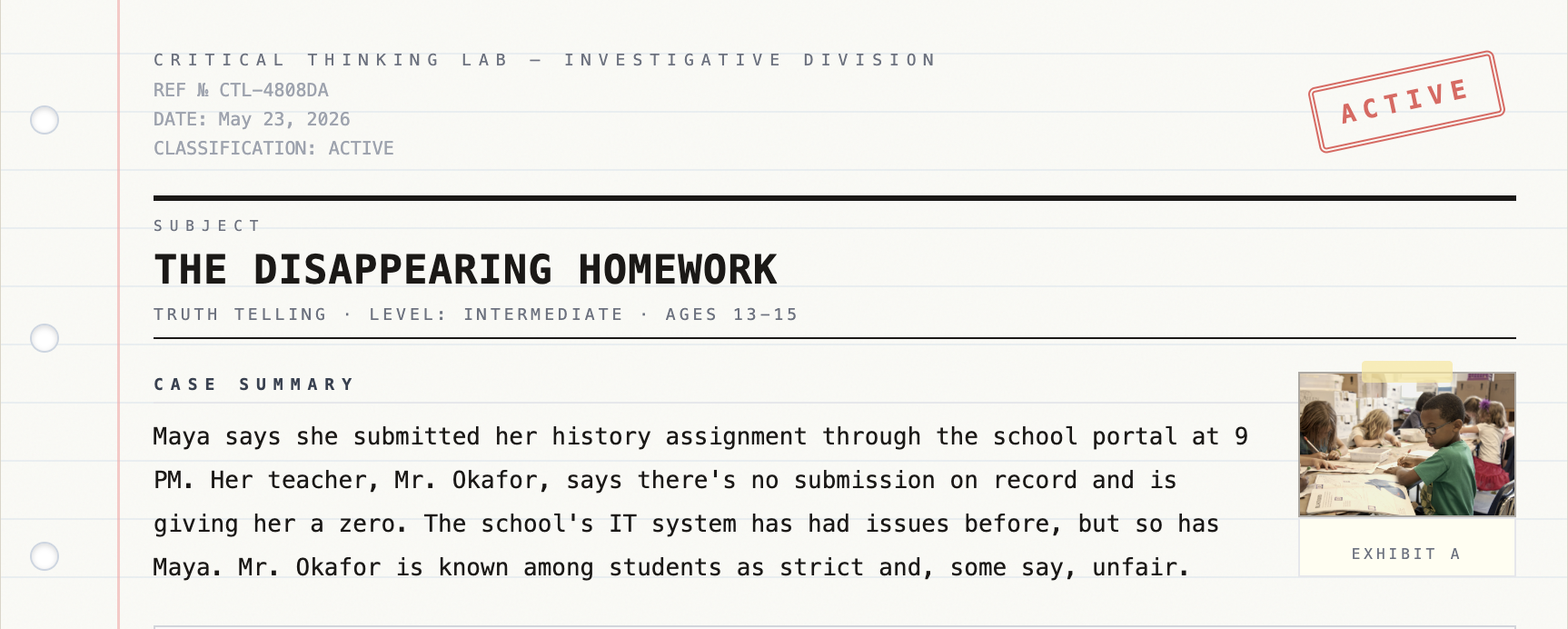
"The Disappearing Homework" is one of the cases on Cogpoppy, The Critical Thinking Lab's web app for teens ages 13–18. The setup is simple: Maya says she submitted her history assignment through the school portal at 9 PM. Her teacher, Mr. Okafor, says there's no submission on record and is giving her a zero. The school's IT system has had issues before, but so has Maya's track record with deadlines. Mr. Okafor, for his part, is known among students as strict, and some say unfair.
Working through the case, teens examine six pieces of evidence, each tagged with a source and a credibility rating. A browser history log. An IT department outage report. A classmate's statement about Maya's habits. A student council complaint log. Some clues are high credibility. Some are low. At least one is there to mislead.
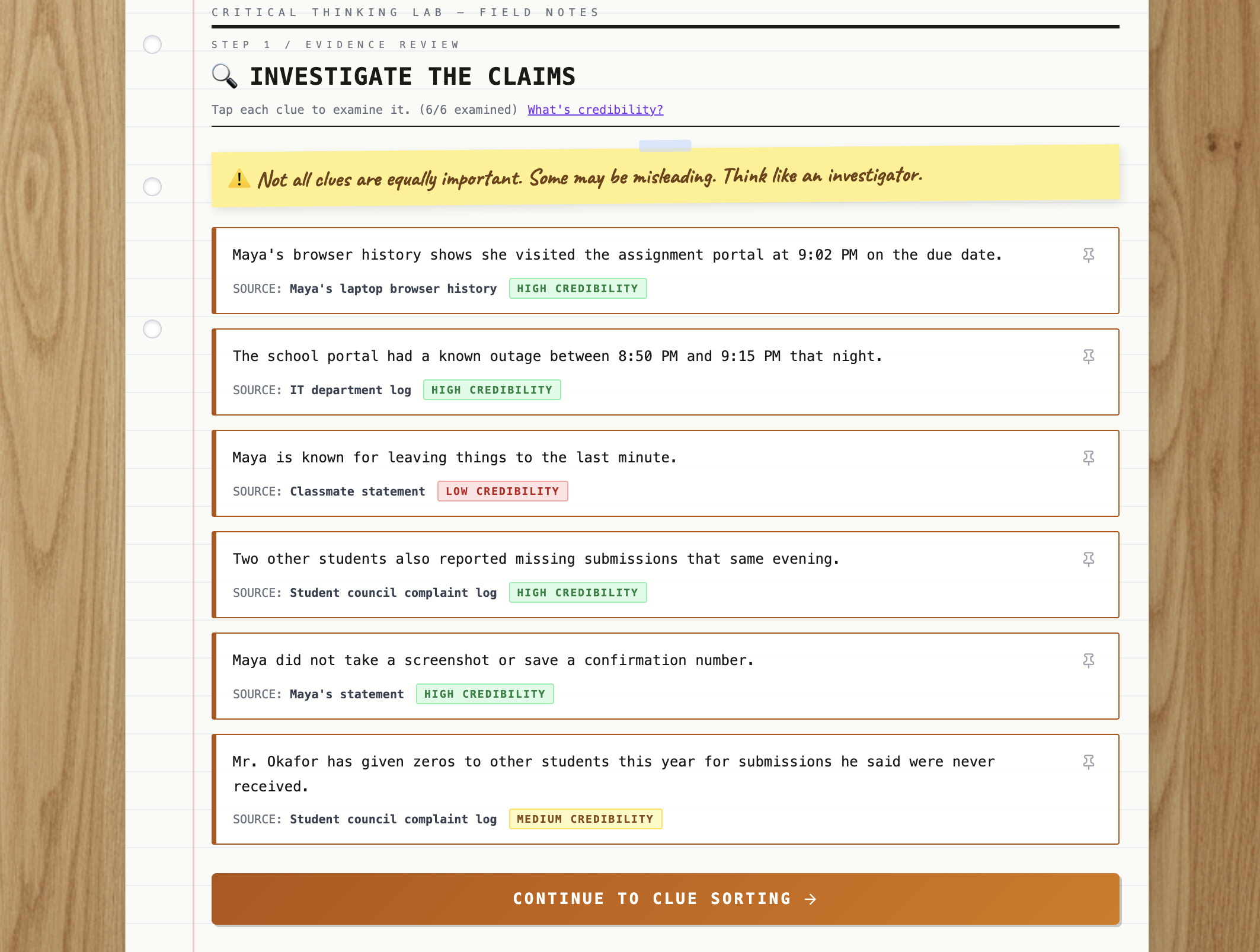
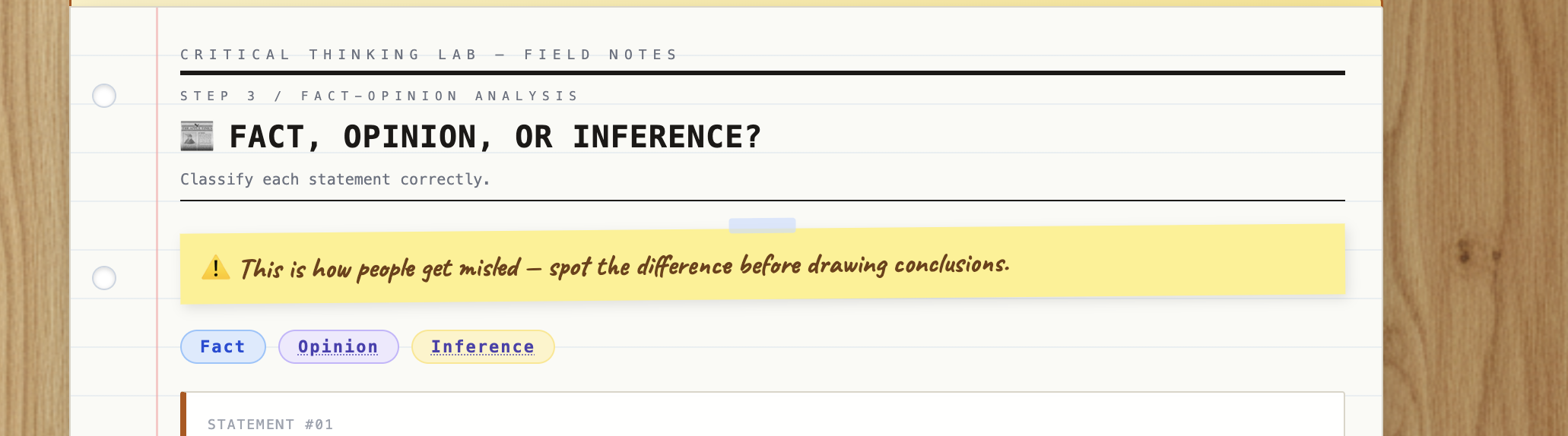
Students sort them, weigh them, classify statements as fact, opinion, or inference, and ultimately build a theory supported by the evidence, not by their gut.
Then comes the part that does the real work.
After the investigation, the case quiz asks students to name what they were actually doing with the information. Did you give too much weight to Maya's reputation? That's anchoring bias….letting past behavior unfairly anchor your judgment of a specific situation. Did you dismiss Mr. Okafor's account because students say he's unfair? That's character bias….evaluating a claim based on who made it rather than what the evidence shows. Did you weigh the clue mentioned first more heavily than the others? That's recency and repetition bias at work.
The case is designed so that both characters carry information that could pull a student's judgment in opposite directions, toward Maya, or toward Okafor, before a single clue has been examined. The point isn't to trick anyone. The point is to make visible the reasoning shortcuts most of us take without realizing it.
So what does a missing homework assignment have to do with a teenager's social media feed?
Everything.
Your teenager isn't evaluating abstract arguments online. They're watching a video that "proves" something about someone they know. They're reading a screenshot being passed around a group chat. They're hearing "everyone knows what she's like" about someone who just got called out publicly. In every one of those moments, the same instincts that show up in the Maya case are already running in the background….and usually, the conclusion has already been reached before the evidence gets a second look.

The teen who caught themselves anchoring on Maya's reputation (and saw it named for what it was) has a better chance of catching themselves doing the same thing in a group chat. Not because they memorized a definition, but because they experienced the bias from the inside, in a situation that felt just real enough to matter.
That's the transfer critical thinking education usually misses. Skills practiced in abstract exercises rarely survive contact with a real situation where something social is at stake. Skills practiced in scenarios that mirror real life, with characters who feel familiar, stakes that feel recognizable, and instincts that actually fire, have somewhere to go.
The homework case is one scenario. Cogpoppy has more, each built around the kinds of situations teenagers actually navigate: questions of truth-telling, competing accounts, social pressure, and decisions where the right answer isn't obvious. Each one is designed to teach reasoning not as a concept, but as something a teenager can feel themselves doing, and catching themselves doing, in real time.
The goal isn't a teenager who can ace a critical thinking test. It's a teenager who pauses, just for a second, the next time a screenshot lands in their feed and everyone already seems to know what it means.
Try Cogpoppy free at cogpoppy.com — or explore conversation cards and simulations for home use at thecriticalthinkinglab.org.