What If This Summer Changed the Way Your Kid Thinks?
It usually starts sometime around week two.
The novelty of no alarm clocks has worn off. The screen time you swore wouldn't get out of hand has quietly doubled. And there's that low-grade parental anxiety, the one that sounds like: are they losing ground? Should I be doing something?
Here's what I want to offer you instead of a checklist: a different way of thinking about what summer actually is.
Because summer isn't an interruption of learning. For the brain, it might be the most important stretch of the whole year, if you know what you're actually trying to build.
The Summer Thinking Window Is Real
Researchers studying cognitive development have long noted that unstructured time plays a distinct role in executive function growth. When kids and teens aren't being directed toward a predetermined outcome, they engage in what learning scientists call generative cognition: the kind of thinking that produces novel connections rather than just retrieves stored ones. It's less like filling a bucket and more like building new plumbing.
What this means practically: the summers where kids and teens get bored, have to figure things out, and make decisions with low stakes are actually doing something. They're building the cognitive flexibility that academic tasks alone rarely develop.
The question isn't whether to let summer be summer. It's whether you're orienting your kid toward thinking while it's happening, or just hoping it shakes out.
The Difference Between Busy and Thinking
Activity is not always the same as learning. A tween or teen can be busy all summer (camps, classes, crafts, travel) and still not practice the skills that actually transfer: noticing assumptions, asking better questions, sitting with uncertainty long enough to think it through.
Fun critical thinking activities for kids and teens aren't a different category of activity. They're ordinary things, oriented differently.
Instead of "what did you do today?" try "what was the hardest decision you made today?"
Instead of giving a child or teen the answer when they're stuck, try "what do you think is true, and what would change your mind?"
Instead of a craft with instructions, try a build challenge with a constraint and no right answer
The activity itself often doesn't change. The thinking orientation does.
What Actually Works for Summer (And Why)
The summer critical thinking activities that hold up in practice share a few characteristics worth naming, because once you see them you can invent your own instead of just following someone else's list.
They're open-ended. There's no single correct answer, which means kids and teens have to actually reason rather than retrieve. Strategy games, design challenges, debate games, "what would you do if" scenarios all work for this reason: there's nothing to look up and no one to wait to be told.
They have low stakes and real decisions. This is why games are so effective for developing critical thinking in kids and teens. Critical thinking games create conditions for genuine reasoning without the pressure that shuts it down. When the worst case is "we lose and play again," kids and teens take intellectual risks they'd avoid in higher-stakes contexts.
They create something worth defending. One of the most underrated summer learning activities for tweens is simply asking them to make an argument for something they care about: a trip they want to take, a rule they think is unfair, a recommendation for the family. When a young person has to construct and defend a position, they're doing exactly what we mean by critical thinking.
They invite your presence, not your direction. The research on parent-child reasoning conversations is unambiguous: kids and teens who regularly talk through problems with adults develop stronger metacognitive skills. You don't have to teach. You have to be genuinely curious alongside them.
This Is What I Mean by "Changed"
When I talk about a summer that changes the way your kid thinks, I don't mean a transformation you'll see on a test in September. I mean something smaller and more durable: a tween or teen who's a little more likely to pause before accepting the first answer. Who asks why more often and means it. Who finds thinking, actual hard thinking, more satisfying than they did in June.
That doesn't come from the right program. It comes from a lot of small moments over a few months, oriented intentionally.
You already have most of what you need. You might just need a few more good questions in your pocket and some company while you figure it out. What does your kid resist thinking about? That's usually where the most interesting conversations are hiding.
If you want a low-pressure starting point, there are a few FREE resources waiting when you subscribe to our weekly newsletter, including one made for exactly this kind of summer. A good place to start without overcomplicating it.
SUBSCRIBE HERE and get your first 10-page critical thinking guide full of ideas for all ages!
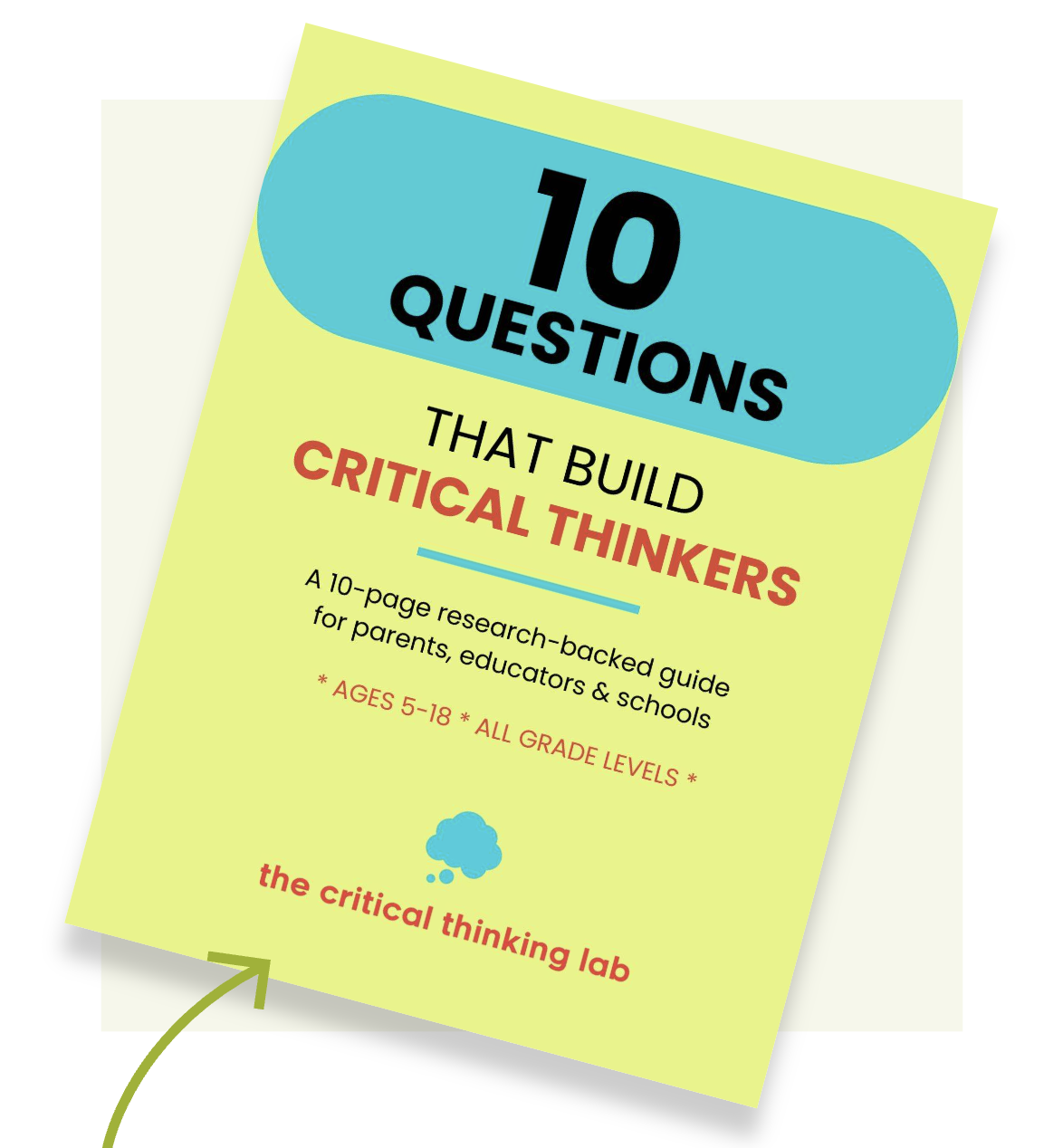
One of our FREE resources available to newsletter subsribers!